
Typing Practice for Weak Keys
A proven, 3-tier training method to eliminate the bottleneck letters dragging down your speed and accuracy.
Practice rule
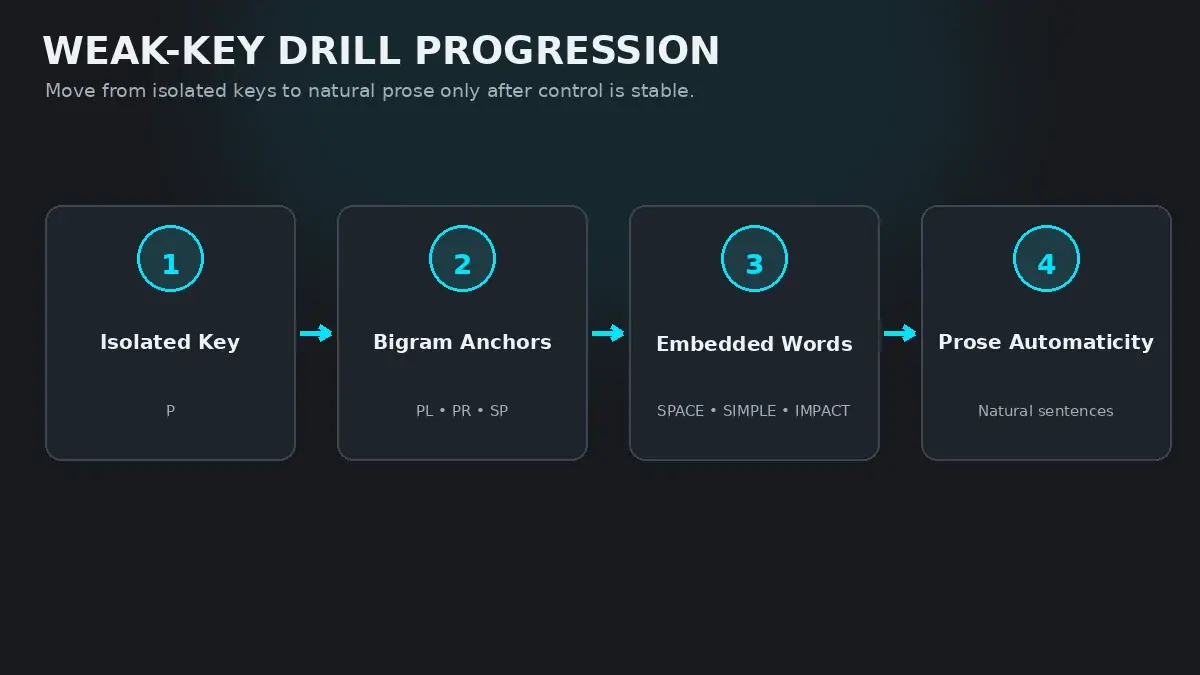
Do not drill problem letters by mashing them repeatedly in isolation. Muscle memory does not store keys in isolation; it stores transitions between letters. Practice your weak keys embedded inside high-frequency bigrams, real words, and natural sentences.
The Repetitive Isolation Trap
When people realize they keep missing a letter like P or B, their first instinct is often to open a blank text document and type p p p p p p p twenty times. This feels productive, but it delivers virtually zero real-world transfer.
In natural English typing, you never press a letter from a dead rest. Your hand is in continuous motion. When typing the word simple, your right pinky must strike P immediately after your right middle finger strikes M, and immediately before your right ring finger reaches for L. That three-finger coordinated sequence is what your nervous system must learn.
If you haven't diagnosed which specific keys are failing yet, read our guide on How to Find Your Weakest Typing Keys first. Once you have your two or three culprit keys, use the 3-tier method below.
The 3-Tier Motor Learning Method
To permanently eliminate a weak key without breaking your overall typing rhythm, move through three progressive stages:
- Tier 1 — High-Frequency Bigrams (2 minutes): Drill the target key paired with the letters that most commonly precede and follow it. For
P, practicepl,pr,sp, andop. This builds the spatial launch vector from adjacent fingers. - Tier 2 — Embedded Word Stems (4 minutes): Type words where the target key appears in the initial, medial, and final positions. For example, drill plan (initial), apple (medial), and crisp (final).
- Tier 3 — Rhythmic Contextual Sentences (4 minutes): Integrate those words into coherent sentences typed with a steady, metronomic cadence at 60% of your maximum speed.
Targeted Bigram Drill Templates
The table below provides proven drill templates for the five keys that most frequently cause stumbles on standard keyboards:
| Target Key & Motion | Core Bigrams | Embedded Words | Sentence Integration Drill |
|---|---|---|---|
| P (Right Pinky Top Reach) | pl, pr, sp, mp, op, ep | play, crisp, jump, proper, apple, simple | People prepare practical plans for simple projects. |
| B (Left Index Long Reach) | bl, br, mb, ob, ab, be | blank, bright, timber, cable, about, better | Brave brothers build bright boats by the blue bay. |
| X (Left Ring Down Reach) | ex, ax, xt, xp, xc, ox | exact, toxic, next, expect, excel, oxygen | Extra foxes examine the next complex text with care. |
| Q (Left Pinky Up-Left Stretch) | qu, sq, eq | quick, square, equal, quiet, squad, equip | The quick queen requested equal quiet across the squad. |
| ; (Right Pinky Home Key) | ;[space], ;[newline] | list; item; code; data; output; | Review each item; verify the data; confirm the outcome. |
Pacing & Progression Rules
When executing weak-key drills, adherence to speed discipline is paramount. The biggest failure mode is attempting to sprint through words containing your problem keys.
- Enforce the 98% accuracy ceiling: If you make an error on the target key during a drill line, stop immediately. You are typing too fast. Back up, drop your pace by 5 WPM, and retype the word cleanly.
- Preserve home-row anchors: When reaching for an upward or downward key, keep your inactive hand resting lightly on its home position. For example, when typing
Bwith your left index finger, ensure your right hand remains stationed onJ-K-L-;. - Avoid physical tension: Stiffening your forearm or wrist when approaching a difficult key restricts tendon mobility. Relax your shoulders, keep your elbows at 90 degrees, and let the finger joints execute the strike.
Your Daily 10-Minute Workflow in HeroTyping
You don't need to manually invent drill sentences every morning. HeroTyping features a dedicated, adaptive practice engine designed specifically for weak-key remediation:
- Go directly to the HeroTyping Weak-Key Practice Tool.
- The engine reads your live mistake history from recent tests and curriculum exercises, automatically generating customized word lines centered on your exact problem keys.
- Complete 3 sets of 3-minute drills. Watch the live accuracy indicator—once your target letter stays above 92% across several runs, the engine automatically clears the weak designation and adjusts your training focus.
- Finish your session with a standard 1-minute run on the Speed Test to consolidate your newly reinforced motor patterns into general typing flow.
FAQ
Why does typing the same weak letter over and over (like 'pppppppp') fail to work?
Typing a single key in isolation requires no spatial movement or contextual finger transitions. In real typing, you never press 'P' alone; you transition into it from another finger (such as 'S' or 'O') and transition out of it to the next key. True muscle memory lives in the transition between keys (bigrams and trigrams), not in the stationary key strike itself.
How slow should I type during weak-key drills?
Drop your speed by roughly 40% to 50% of your maximum WPM. If you normally type at 70 WPM, conduct your weak-key drills at 35 to 40 WPM. The purpose of the drill is to imprint a completely clean, effortless motor path into your cortex without hesitation or muscular tension.
How long does it take to fix a stubborn weak key?
Most typists resolve a diagnosed weak key within 3 to 5 consecutive days of deliberate 10-minute daily practice. Because you are targeting a specific neural motor sequence rather than general typing, progress occurs remarkably fast once targeted bigrams are practiced.
When should I graduate a weak key back to regular typing?
Graduate the key when you can complete three consecutive 1-minute drills containing the target key with at least 98% accuracy and zero hesitation pauses. In HeroTyping, the automated tracker clears the weak status once your rolling accuracy exceeds 90% across 6+ live attempts.
Sources & references
- Contextual Interference Effects in Motor Skill Acquisition — Magill, R. A., & Hall, K. G. (Perceptual and Motor Skills, 1990)
- Deliberate Practice and the Acquisition of Expert Performance — Ericsson, K. A., Krampe, R. T., & Tesch-Römer, C. (Psychological Review, 1993)
- The Role of Sub-word Chunking and Bigram Frequency in Touch Typing — Gentner, D. R. (Cognitive Science, 1983)