
911 Dispatcher Typing Test: Requirements, CritiCall & How to Pass
The complete guide to public safety typing benchmarks, audio-to-CAD transcription, alphanumeric data entry, and passing the CritiCall exam.
Agency Hiring Disclaimer
Specific WPM cutoffs, computerized testing systems (such as CritiCall, TypingTest, or custom CAD simulations), and passing thresholds vary significantly by municipality, county, state/provincial agency, and dispatch center. Always consult the specific civil service job announcement or recruitment department for the exact testing requirements in your jurisdiction.
Public Safety Accuracy Rule
In civilian typing, a typo is a minor inconvenience. In 911 emergency dispatch, transposing two digits in an address or miskeying an apartment number delays first responders when seconds count. For this reason, net accuracy (95% to 98%+) and flawless alphanumeric entry carry far more weight in hiring decisions than raw, erratic WPM speed.
Emergency dispatch console
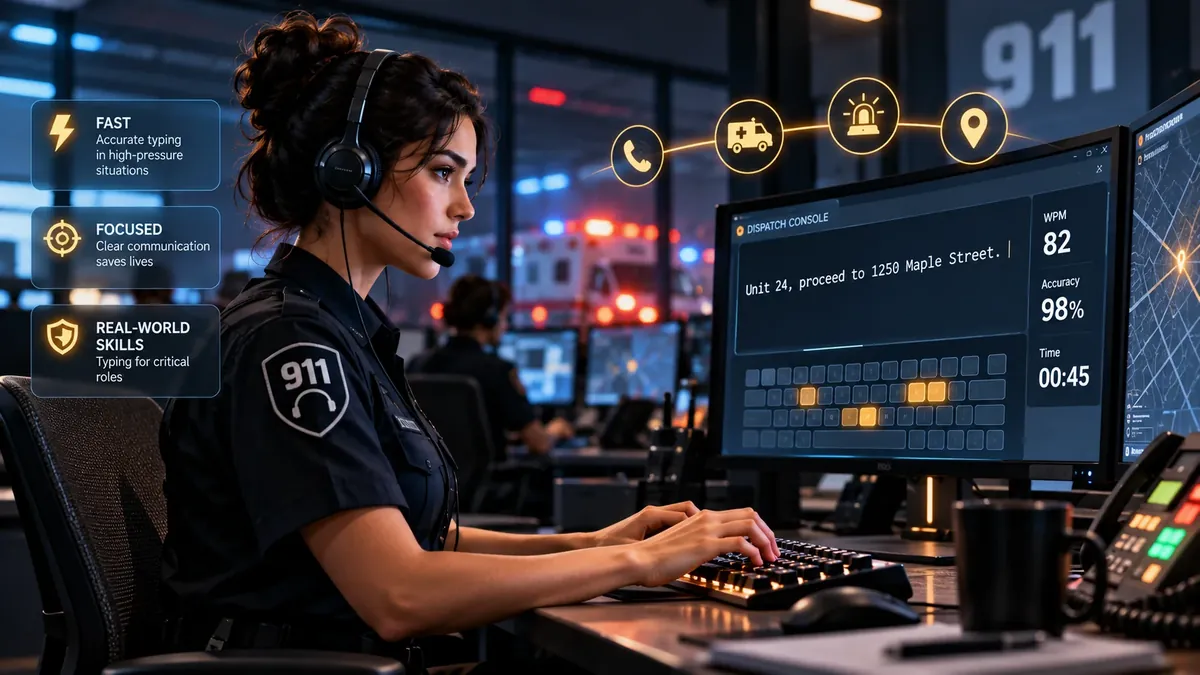
Emergency communications dispatchers are the critical first link in public safety. Before police officers, firefighters, or paramedics arrive at a scene, a 911 operator has gathered the caller's location, verified the nature of the emergency, cross-referenced hazard databases, and dispatched units via a Computer-Aided Dispatch (CAD) console.
To ensure candidates can handle high-stress data entry without freezing, many municipal, county, and state agencies administer rigorous pre-employment typing exams, frequently utilizing the CritiCall examination battery or agency-specific CAD simulations.
Why 911 typing is fundamentally different from everyday typing
Taking a standard typing test tests your ability to read printed text on a monitor and re-type it. A 911 dispatcher rarely does this.
Instead, emergency typing demands three distinct neurological skills:
- Dichotic Listening & Typing: You must listen to hysterical, sobbing, or whispering callers through a headset while simultaneously typing structured notes into CAD fields without interrupting the caller.
- Alphanumeric Precision: You will constantly enter complex sequences of mixed letters and numbers: license plates (e.g.
7XYZ491), 17-character VINs, street addresses (e.g.14022 N 84th Pl #3B), and phone numbers. - Multi-Window Navigation: Shifting instantly between form fields using the
Tabkey, arrow keys, and functional hotkeys rather than reaching for a mouse.
The CritiCall test modules explained
Developed by Biddle Consulting Group, CritiCall tests real-world public safety competencies. The primary typing and data-entry sections include:
- Audio Data Entry: You hear simulated 911 calls over headphones. As the caller speaks, you must input the caller's name, address, phone number, and incident type into the correct CAD software boxes in real time.
- Cross-Referencing: You are given an address or name and must rapidly find the matching record in a side table, verify the jurisdiction, and key in the verified responding station.
- Data Entry (Ten-Key & Alphanumeric): Timed entry of numeric and alphanumeric codes, scored strictly on keystrokes per hour (KPH). Review our data entry typing test guide for detailed KPH conversions.
- Call Summarization: Listening to a short emergency call and typing a concise, factual 2-sentence summary without spelling or grammatical ambiguities.
Agency passing standards table
| Test Section | Speed Benchmark | Accuracy Threshold | Evaluation Scope |
|---|---|---|---|
| Standard Prose Typing Test | 35 to 45+ Net WPM | 95% to 98% minimum | Timed 3 to 5-minute test assessing baseline typing speed and net accuracy on administrative text. |
| Audio Data Entry (Audio-to-CAD) | 35 to 40 WPM real-time | 98% minimum | Listening to simulated 911 caller audio tapes and entering names, locations, and descriptions simultaneously into dispatch fields. |
| Alphanumeric Cross-Referencing | 3,500 to 5,000+ KPH | 95% minimum | Rapidly matching and inputting mixed alphanumeric codes: VIN numbers, driver's licenses, license plates, and street numbers. |
| Call Summarization & Priority | 80% composite score | No critical field omissions | Synthesizing chaotic caller statements into concise, actionable dispatch summaries while determining unit dispatch priority. |
Mastering addresses & top-row numbers
The most common reason capable typists score poorly on CritiCall is hesitation on the number row. When an applicant has to look down at their hands to find the “7” or the “#” symbol, their rhythm collapses and they fall behind the audio stream.
To build automatic alphanumeric muscle memory:
- Master our dedicated guide on how to type numbers and symbols without looking.
- Anchor your index fingers to the F and J home keys and practice blind reaches to 4, 5, 6, 7 until you can enter any phone number with your eyes closed.
- Practice typing full address strings: “742 Evergreen Terrace Apt 4B” until you can switch between letters, numbers, and capital shifts without pausing.
4-week dispatcher prep plan
- Week 1 (Form & Blind Typing): Take daily 5-minute typing tests on our English practice modules. Enforce a strict 98% accuracy threshold. If you look down at the keyboard, restart the test.
- Week 2 (Numbers & Ten-Key KPH): Spend 20 minutes daily on the top number row and numeric keypad. Calculate your KPH using our WPM, CPM & KPH Calculator to ensure you exceed 4,000 KPH.
- Week 3 (Audio Multitasking): Put on headphones, play a news broadcast or podcast, and practice transcribing names, dates, and locations into a blank document in real time without pausing the audio.
- Week 4 (Simulated Pressure): Take full-length 5-minute tests under time constraints, ensuring your net WPM stays comfortably above 45 WPM even under stress.
FAQ
What WPM typing speed is required for a 911 dispatcher?
Many emergency communications agencies require a baseline typing speed between 35 and 45 Net WPM, though exact benchmarks vary by agency and jurisdiction. Passing the hiring test is not just about raw speed: candidate evaluations test your ability to type accurately while listening to emergency audio and inputting complex alphanumeric strings (addresses, license plates, phone numbers).
What is the CritiCall test?
CritiCall is a widely used computerized pre-employment testing battery developed for public safety and 911 emergency communications centers. It assesses multitasking skills including audio data entry, reading comprehension, address cross-referencing, map reading, memory recall, and priority dispatch decision-making.
Why do so many candidates fail the 911 dispatcher typing test?
Candidates usually fail not because they cannot type 40 WPM on a normal keyboard test, but because they struggle with audio multitasking. Typing while actively listening to frantic caller audio—or misplacing digits in 17-digit vehicle identification numbers (VINs)—triggers disqualifying error deductions.
How long should I prepare before taking the CritiCall examination?
We recommend 3 to 4 weeks of structured daily practice. Focus on blind typing (never looking at your hands), audio dictation drills, and top-row number/symbol speed using our data entry practice tools.
Sources & references
- Biddle Consulting Group — CritiCall Public Safety Dispatcher Pre-Employment Testing System
- National Emergency Number Association (NENA) — Core Competencies and Minimum Training Standards for Public Safety Telecommunicators
- Association of Public-Safety Communications Officials (APCO International) — Standards for 9-1-1 Telecommunicator Candidates
Last updated 2026-09-26.