
Typing Test vs Typing Practice
Why taking endless speed tests causes plateaus, and how to harness the 80/20 rule of deliberate practice.
Core principle
A typing test evaluates your current performance under pressure. A practice session builds new neural connections and repairs mechanical flaws. If 90% of your keyboard time is spent taking tests, you will plateau within weeks. Apply the 80/20 rule: 80% deliberate practice, 20% testing.
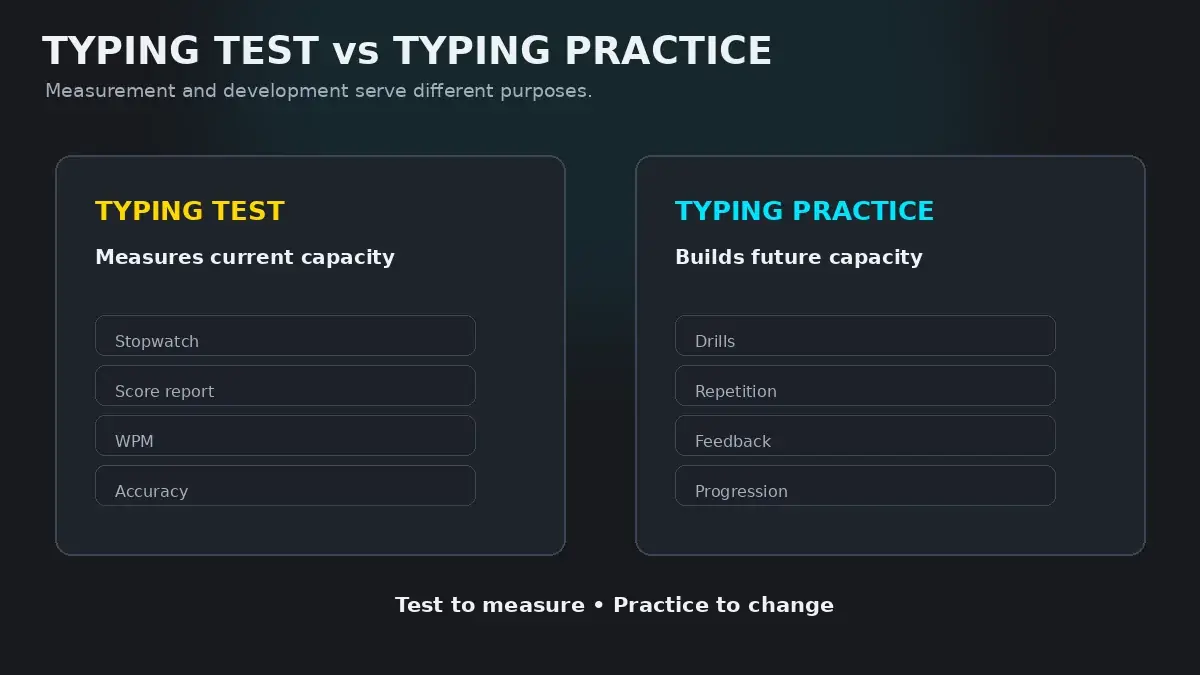
The Fundamental Distinction
In the world of keyboard training, the words testing and practicing are frequently treated as synonyms. People say: "I practiced typing for 20 minutes today," when what they actually did was take twenty consecutive 60-second speed tests.
This confusion is the number one cause of long-term speed plateaus.
In sports science, an athlete does not prepare for a marathon by running a full marathon every single morning. A sprinter does not prepare for an Olympic final by doing thirty 100-meter sprints back to back. Instead, they spend 80% of their time on deliberate sub-skills: mobility drills, strength training, cadence intervals, and technique refinement. The race itself is merely the evaluative event.
Typing follows the exact same physiological laws. Testing measures your existing capacity; deliberate practice builds new capacity.
Side-by-Side Comparison Matrix
Review how typing tests and typing practice differ across every critical dimension:
| Dimension | Typing Test | Typing Practice |
|---|---|---|
| Core Purpose | Measurement & Evaluation: Records current speed, accuracy, and error rates under time pressure. | Skill Acquisition & Correction: Remaps neural pathways, expands keyboard reach, and corrects specific errors. |
| Cognitive State | High evaluative pressure, competitive anxiety, reliance on existing motor habits (good and bad). | Low pressure, experimental, deliberate focus on finger micro-mechanics and posture. |
| Speed Target | Maximum comfortable velocity (aiming for peak WPM without collapsing accuracy). | Deliberately slow pace (50%–70% of peak speed) to ensure flawless 98%+ accuracy. |
| Error Handling | Speed-penalty correction or skipping under running timer. | Instant stop on mistake, diagnostic root-cause analysis, and slow deliberate retyping. |
| Optimal Weekly Share | 20% of total keyboard training time (e.g. 3–5 minutes per day). | 80% of total keyboard training time (e.g. 12–15 minutes per day). |
Why Endless Testing Causes Plateaus
When you take a typing test, a timer counts down on the screen. The presence of the clock immediately triggers mild autonomic arousal: your heart rate elevates, your forearm muscles tense slightly, and your brain prioritizes speed over exploration.
Under this stress, your nervous system automatically defaults to its most ingrained motor pathways. If you have a bad habit—such as pecking the B key with your right hand or flying your wrists off the home row—the stress of a test forces you to use that bad habit because it feels familiar in the moment.
By taking test after test, you literally rehearse and solidify your existing technical limitations. You cannot fix a motor flaw while under the pressure of the clock that created the flaw in the first place.
The 80/20 Training Ratio
To achieve consistent, compounding WPM gains, structure your training around the 80/20 Rule:
- 80% Deliberate Practice (12–15 Minutes): Spend this time on un-timed or slow-tempo activities: working through the Curriculum Lessons, drilling diagnosed Weak Keys, practicing difficult rows, or typing domain-specific syntax in Custom Mode.
- 20% Evaluative Testing (3 Minutes): Dedicate this time to one or two 60-second runs on the Speed Test to measure progress, benchmark consistency, and uncover new diagnostic error patterns.
Balancing Both in HeroTyping
HeroTyping is intentionally designed to provide both halves of this equation in one place:
- For Practice: Use the 28-Lesson Curriculum and the adaptive Weak-Key Practice Tool to systematically build flawless motor memory.
- For Testing: Use the HeroTyping Speed Test to evaluate your Net WPM, accuracy, and consistency metrics under realistic conditions.
FAQ
Why can't I improve my typing speed just by taking 50 typing tests a day?
Because a typing test only measures your current ability; it doesn't teach your fingers new habits. Taking 50 tests a day is like stepping on a bathroom scale 50 times hoping to lose weight. To improve, you must step off the scale and lift weights—which in typing means doing structured drills, fixing weak keys, and learning proper finger geometry.
When should I take a typing test during my practice session?
Take one diagnostic test at the beginning of your session (after a 2-minute physical warmup) to establish a baseline, and take one final test at the end to evaluate progress. The middle 80% of your session should be devoted entirely to deliberate practice drills.
What is the biggest trap when doing typing practice?
The biggest trap is practicing too fast. Many typists treat practice drills like mini speed tests, rushing through them and making mistakes. Practice must be conducted at a deliberately relaxed, slow tempo where 98%+ accuracy is guaranteed.
How do I know when my practice is actually paying off in real speed?
Track your weekly rolling average Net WPM on 60-second tests. When your deliberate practice succeeds, you will notice that typing feels effortless, your consistency percentage rises above 80%, and your error count drops to 1 or 2 per minute.
Sources & references
- Deliberate Practice and the Acquisition of Expert Performance — Ericsson, K. A., Krampe, R. T., & Tesch-Römer, C. (Psychological Review, 1993)
- Testing Effects in Motor Skill Acquisition: Testing vs. Training Paradigms — Kromann, C. B., et al. (Medical Education, 2009)
- Motor Learning and Performance: From Principles to Application — Schmidt, R. A., & Lee, T. D. (Human Kinetics, 2019)