
Typing Practice for Difficult Keys & Reaches
Remedial biomechanics for corner reaches, pinky weakness, and low-frequency stumbling blocks.
Biomechanical fact
Your ring and pinky fingers are physically bound together by shared tendon sheaths (the juncturae tendinum). Struggling with corner keys like Q, Z, X, P is not a personal failure; it is human anatomy. With the right anchor-pivot technique, you can overcome this natural limitation completely.
Why Certain Keys Cause Stumbles
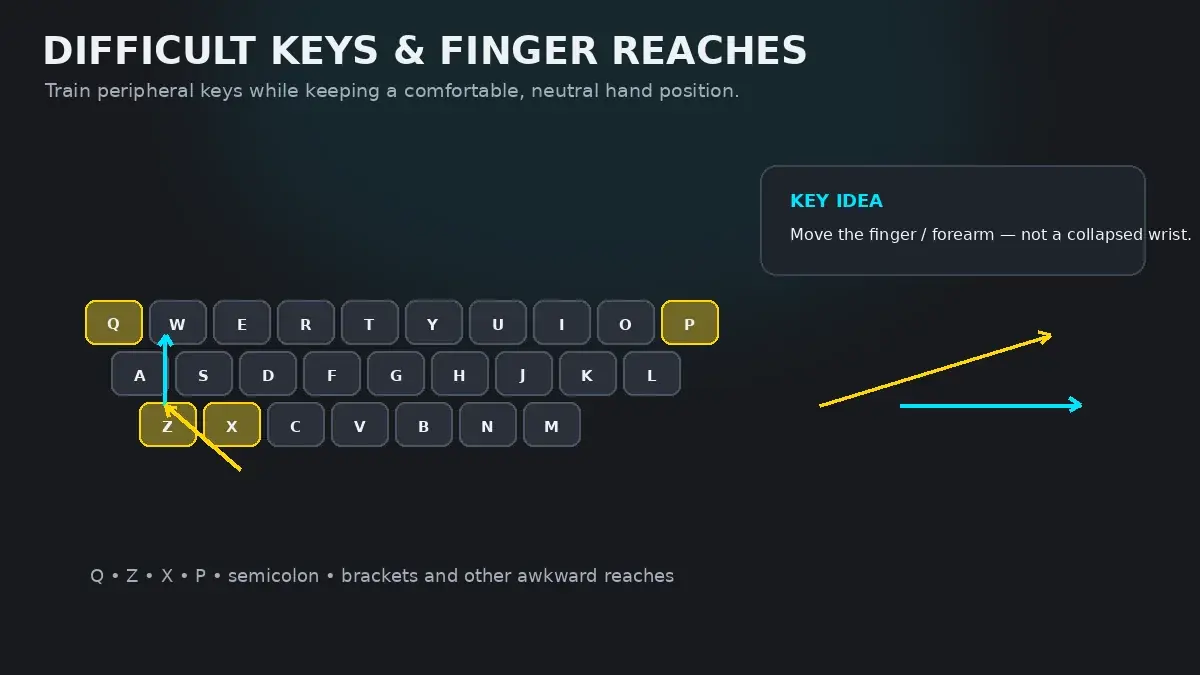
In every typist's journey, 80% of typing errors cluster around fewer than 20% of the keys. Letters likeQ, Z, X, P, B and symbols like brackets and semicolons are notorious for triggering hesitation pauses, adjacent misstrikes, and hand tension.
These keys are difficult for three reasons:
- Low Natural Frequency: In English text, letters like
ZandQappear rarely. You get 50 times more practice onEandTduring normal typing, leaving your neural pathways for rare keys underdeveloped. - Peripheral Keyboard Geometry: Keys like
Q, P, Zsit on the outer edges of the keyboard, requiring maximum reach distance away from your resting home-row anchors. - Anatomical Tendon Coupling: Your pinky finger relies on the smaller extensor digiti minimi muscle, which has less independent motor control than your index or middle fingers.
The Hardest Keyboard Reaches Breakdown
Review the five most mechanically challenging reaches and their exact biomechanical remedies:
| Difficult Key | Difficulty Level | Biomechanical Obstacle | Targeted Technique Remedy |
|---|---|---|---|
| Q (Left Pinky Up-Left) | High (Extreme corner reach) | Requires extending the extensor digiti minimi tendon diagonally while keeping the palm square. | Anchor left middle on D; let pinky extend upward without letting the wrist swing leftward. |
| Z (Left Pinky Down-Left Curl) | Very High (Tendon compression) | Curling pinky backward toward the palm with limited independent flexion mobility. | Float wrist 1.5 cm above desk. Never plant wrist on the desk surface when curling to Z. |
| X (Left Ring Down-Right Curl) | High (Adjacent finger dependency) | Ring finger shares flexor tendon sheaths with middle and pinky, causing co-activation errors. | Drill 'sx' and 'ex' bigrams at 50% speed. Keep index anchored on F. |
| P (Right Pinky Up-Right) | Moderate to High (Perimeter reach) | Frequent letter in English (unlike Q or Z), creating high cumulative fatigue on the right pinky. | Relax shoulder; allow forearm to pivot micro-fractions from the elbow rather than straining the finger. |
| B (Left Index Diagonal Stretch) | High (Center column divide) | Longest diagonal index-finger reach across the keyboard divide. | Strict discipline: always use left index from F. Never let the right hand cross over. |
Mastering Pinky Finger Agility
To unlock effortless pinky reaches without pain or strain:
- Never plant your wrists: If your wrists are glued to the desk, your pinky is forced to stretch past its anatomical comfort zone. Floating your wrists allows your whole forearm to rotate slightly, bringing the pinky directly over the keycap.
- Relax the ring finger: When reaching for
QorZ, don't fight your ring finger if it moves slightly in sympathy. Allow natural finger coupling while focusing on fingertip contact. - Use light actuation: Corner keys do not require heavy force. Modern membrane and mechanical switches actuate with just 45 to 60 grams of force—a gentle, relaxed tap is all that is required.
The Anchor-Pivot Technique
The secret to striking difficult keys without getting lost on the keyboard is the Anchor Pivot:
When your left pinky reaches up-left for Q, keep your left middle finger lightly resting on D. The middle finger acts as a compass needle: your hand pivots slightly around that anchor point, reaches for Q, and snaps immediately back to A without your brain ever losing track of keyboard space.
Targeted Remedial Drills
Drill these specialized word patterns at 50% of your normal speed to build deep confidence on difficult keys:
Drill 1: The Q & Z Peripheral Reach
quiz quick equal quiet zero zinc freeze amaze qualify quartz
Drill 2: The X & C Differentiation Drill
exact toxic complex expect accept exceed cancel excite fixture
Drill 3: The P Pinky Endurance Drill
people prepare prompt paper prompt purpose typical simple proper
Drill 4: The B & N Central Index Reach
combine banana balance boundary blanket business neighbor brown
Want automated practice customized to your personal bottleneck keys? Open the adaptive HeroTyping Weak-Key Practice Tool to generate real-time drill text tailored to the keys you struggle with most.
FAQ
Why do the pinky fingers feel so much weaker and clumsier than other fingers?
Human hand anatomy naturally links the ring and pinky fingers through shared tendon connections in the deep flexor muscles of the forearm. In addition, the pinky is actuated by the smaller 'extensor digiti minimi' muscle, which has fewer motor units and less cortical representation in the brain than the index or middle fingers. Building pinky independence requires deliberate, slow practice.
Should I move my whole hand or just stretch my finger when reaching for corner keys?
Use an 'anchor pivot': your wrist floats in neutral position, your inactive fingers stay close to the home row as a tether, and your hand pivots slightly from the wrist and elbow to allow the finger to reach without straining. Never lift your entire hand into the air.
Why do I keep pressing C instead of X?
Because the keyboard rows are staggered to the right. When your left ring finger curls down from 'S', reaching straight down lands on 'C' (which belongs to the middle finger). To hit 'X', your ring finger must curl down and slightly right.
How can I strengthen my pinky fingers for typing?
Tendon glides and daily 5-minute dedicated bigram drills (practicing 'pl', 'pr', 'qa', 'qu', 'za', 'ze') build pinky coordination rapidly. Avoid hand-grip strengtheners, which build gross crushing power rather than fine motor independence.
Sources & references
- Anatomical Variations and Tendon Interconnections of the Extensor Digiti Minimi — Zilber, S., & Latil, F. (Surgical and Radiologic Anatomy, 2004)
- Independence of Individual Finger Movements in Humans — Schieber, M. H. (Journal of Neuroscience, 1991)
- Electromyography of Extensor and Flexor Tendons in High-Speed Repetitive Keystrokes — Sommerich, C. M., et al. (Ergonomics, 1998)