
Typing Games vs Typing Tests
Unpack the science of gamified learning, stress inoculation, reflex automaticity, and when each tool shines.
Balanced approach
Typing tests measure steady transcription rhythm. Typing games train reaction speed and stress tolerance. Neither is superior on its own; elite typists use structured lessons for technique, tests for baseline measurement, and games for dynamic reflex conditioning.
The Great Typing Debate: Play or Measure?
In the typing community, opinions on games are sharply divided. Traditionalists view typing games as frivolous distractions that encourage sloppy technique and reckless button-mashing. On the other side, gamification enthusiasts claim games are the only way to stay engaged and that standard tests are too boring to sustain.
Cognitive science demonstrates that both camps are half right.
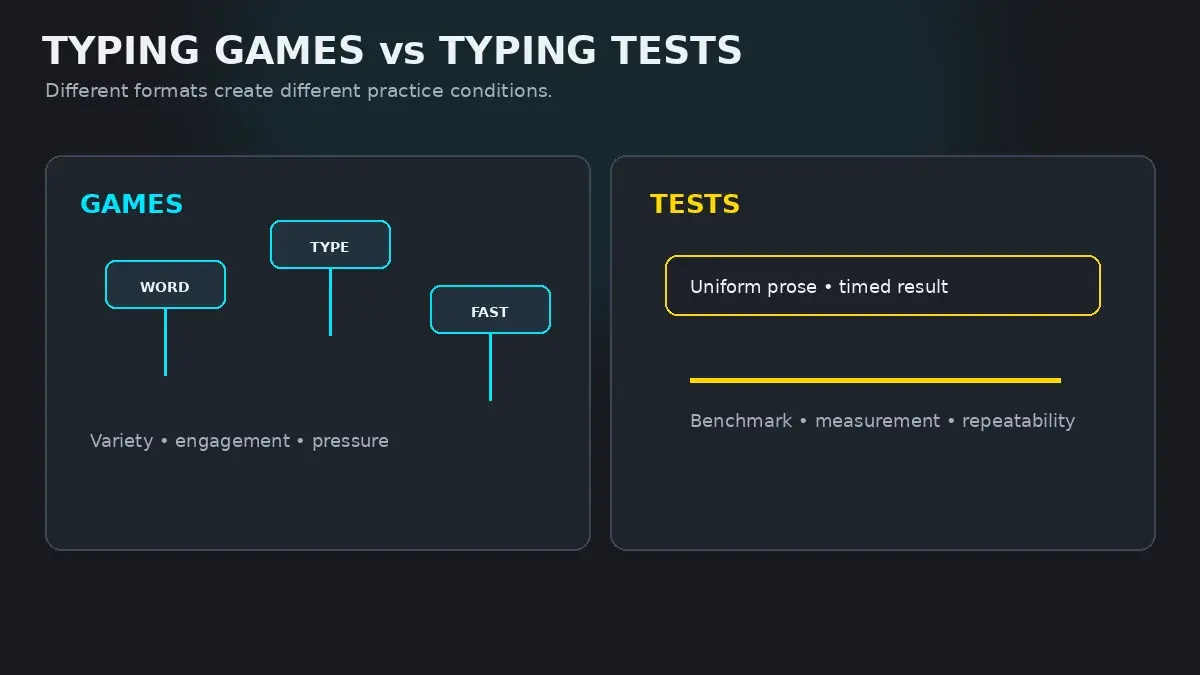
A standard typing test presents predictable, static lines of text. Your brain operates in an anticipatory mode, smoothly buffering words ahead of the cursor. In contrast, an arcade typing game throws unexpected words from multiple directions under descending time limits. This forces your motor system to bypass conscious deliberation and execute ballistic motor programs instantly.
Games vs. Tests Side-by-Side Comparison
Review how gaming and testing engage different neurological systems:
| Dimension | Typing Games | Typing Tests |
|---|---|---|
| Primary Cognitive Driver | Reaction time, visual tracking, stress tolerance, and dynamic priority shifting. | Linear transcription, eye-hand span buffer, sustained rhythm, and metronomic consistency. |
| Time Pressure Dynamics | Dynamic & visual: descending meteors, charging enemies, shrinking bonus timers. | Static clock: fixed 15s, 60s, or 120s countdown with fixed horizontal text lines. |
| Accuracy Consequences | Life loss, combo breaker, game over screen—instant visceral feedback. | Statistical penalty: Net WPM reduction and red character highlights. |
| Engagement & Dopamine | High replayability, arcade scores, audiovisual reward loops. | Self-driven motivation, benchmark tracking, analytical reflection. |
| Ideal Application | Breaking monotony, training high-stress reflexes, fun cooldowns. | Formal benchmark evaluation, diagnostic error logging, workplace readiness. |
Stress Inoculation & Reflex Conditioning
Why do typing games often help typists break through stubborn speed plateaus?
- Stress Inoculation: In psychology, stress inoculation is the process of training under mild, controlled anxiety so that performance remains stable under real-world pressure. Typing games recreate this pressure with falling objects, ticking timers, and high-score stakes.
- Eliminating Overthinking: On standard tests, typists often over-analyze each finger reach, causing micro-hesitations. A fast-paced arcade game forces you to let go of conscious control and trust your hands to execute instinctively.
- Dopamine and Habit Loops: Let's face it: taking 20 speed tests in a row can feel dry. Earning combo multipliers, leveling up, and beating arcade boss stages provides genuine psychological fun that keeps learners coming back day after day.
The Pitfalls of Gamified Typing
Despite their benefits, relying exclusively on games comes with real dangers:
- Form Degradation: Under intense panic in a game, learners often abandon home-row posture and revert to pecking with their index fingers just to keep the game alive.
- Unrealistic Vocabulary: Many games repeat short 3- and 4-letter words (like cat, bat, sun) that don't reflect the complex multi-syllabic vocabulary of real-world emails or essays.
- Lack of Punctuation: Most arcade games ignore punctuation, capitalization, and numbers, leaving those critical keyboard skills untrained.
The Optimal Hybrid Routine in HeroTyping
The best training regimen leverages the unique strengths of every tool in the HeroTyping ecosystem:
- Build Technique (10 min): Learn proper finger placement and row mechanics in HeroTyping Lessons.
- Measure Precision (2 min): Take a clean, controlled 60-second baseline run on the HeroTyping Speed Test.
- Sharpen Reflexes (3 min): Finish your session with a high-energy round in HeroTyping Arcade Games (try Fruit Fury or Type Defender) to cement your neuromuscular reflexes with high engagement.
FAQ
Do typing games actually build real-world typing speed, or are they just entertainment?
Typing games build genuine speed by training reflex automaticity and stress inoculation. In an arcade game where words fall from the sky, you don't have time to consciously think about finger placement; your motor system must react ballistically. However, games alone won't teach structured home-row anchoring—they work best combined with formal curriculum lessons.
Can typing games cause bad typing habits?
Yes, if the game rewards speed without heavily penalizing errors. When players rush to shoot down falling words, they often resort to messy, two-finger mashing. To prevent bad habits, play games that penalize mistakes (such as breaking combos or losing health).
How should I fit games into my daily practice routine?
Use games as the final 3- to 5-minute reward phase of your practice session. After completing your daily curriculum lessons and weak-key drills, finish with an arcade game like Fruit Fury or Type Defender to test your newly trained reflexes in a fun, dynamic setting.
Which typing game on HeroTyping is best for beginners?
Falling Words is the best starting point for beginners because words descend at a controlled velocity, giving you time to visually identify the target and execute clean keystrokes without overwhelming stress.
Sources & references
- Gamification in Perceptual-Motor Skill Training: A Systematic Meta-Analysis — Sailer, M., & Homner, L. (Educational Psychology Review, 2020)
- Stress Inoculation Training and Motor Performance Under High Pressure — Saunders, T., et al. (Journal of Applied Sport Psychology, 1996)
- Action Video Games and the Enhancement of Visual Motor Reflexes — Green, C. S., & Bavelier, D. (Nature, 2003)