
How to Structure a Typing Practice Session
A proven, 15-minute 4-phase training template that delivers continuous WPM gains without burnout.
Training structure
Treat typing like an athletic workout. You would never walk into a gym, skip the warmup, attempt your maximum bench press immediately, and leave. Structuring your 15 minutes into four distinct phases—Warmup, Curriculum, Remediation, and Cooldown—doubles your learning rate.
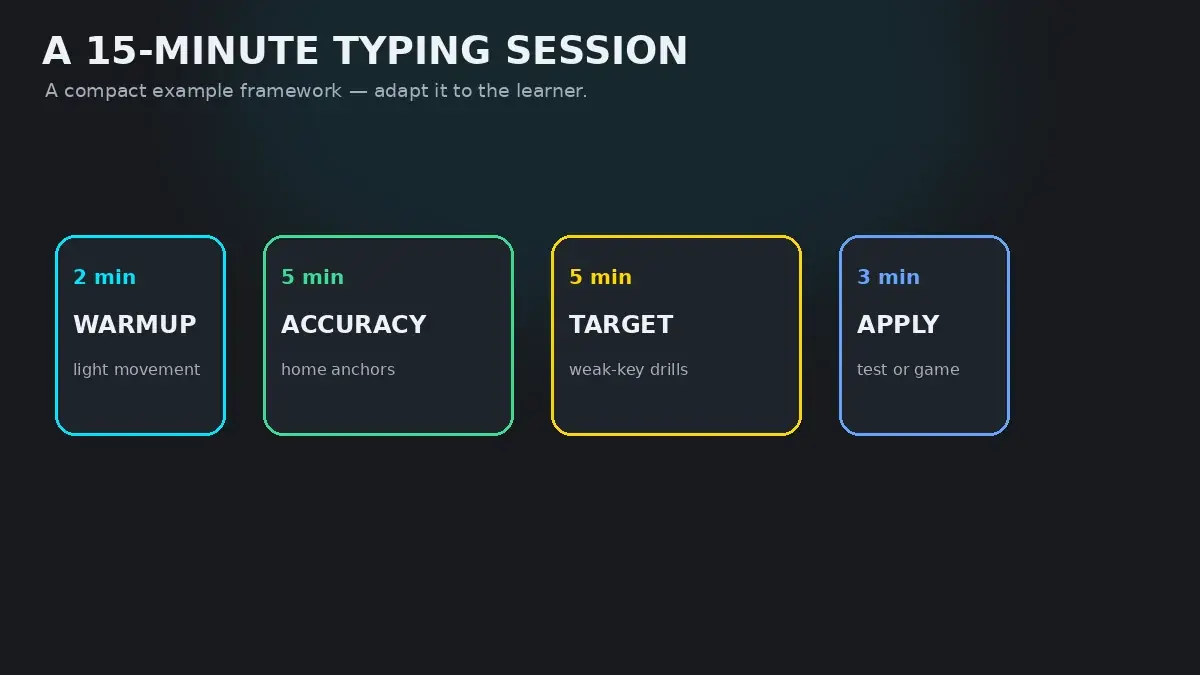
The Athletic Workout Model for Typing
Most people approach typing practice haphazardly: they open a website, take three random speed tests, make a bunch of errors, get frustrated, and close the tab.
This unstructured approach yields agonizingly slow progress. You cannot build speed, accuracy, and endurance all at the same time in the same drill. Each of these attributes requires distinct cognitive conditions:
- Warmup: Lubricates tendons and calibrates spatial coordinates.
- Deliberate Curriculum: Expands your conscious motor map into new keys.
- Remediation: Identifies and fixes your unique personal error patterns.
- Cooldown: Integrates everything into natural, unconscious flow under time pressure.
The 4-Phase 15-Minute Session Structure
Here is how an optimal daily 15-minute typing workout is allocated:
| Phase | Time | Primary Training Objective | Recommended HeroTyping Tool |
|---|---|---|---|
| Phase 1: Physical Warmup & Calibration | 2 Minutes | Tendon glides, wrist circles, and 1 slow warmup test at 50% speed. | Typing Stretches Guide & Warmup Run on Speed Test |
| Phase 2: Curriculum Progression | 5 Minutes | Deliberate skill acquisition: new finger reaches, row mastery, or punctuation exercises. | HeroTyping Lessons Dashboard (Target Lesson) |
| Phase 3: Weakness Remediation | 5 Minutes | Targeting diagnosed bottleneck keys, troublesome bigrams, and accuracy recovery. | HeroTyping Weak-Key Practice Drill (/lessons/practice) |
| Phase 4: Cooldown & Evaluation | 3 Minutes | One 60-second benchmark test or a 2-minute arcade typing game for flow integration. | HeroTyping Speed Test (60s) or Arcade Games |
Detailed Phase-by-Phase Execution
Phase 1: Warmup & Calibration (2 Minutes)
Start with 60 seconds of gentle tendon glides and finger spreads. If your hands are cold, run them under warm water or rub your palms together. Then take one 60-second test on the Speed Test at exactly 50% of your maximum speed. The goal is 100% accuracy and physical relaxation.
Phase 2: Curriculum Progression (5 Minutes)
Open HeroTyping Lessons. Work on your current active lesson module—whether that is top-row reaches, bottom-row curls, numbers, or punctuation. Focus entirely on clean finger mechanics and zero looking down.
Phase 3: Weakness Remediation (5 Minutes)
Switch directly to the HeroTyping Weak-Key Practice Tool. This tool automatically analyzes your mistakes from Phase 2 and generates customized drills around the letters you missed. Drill those bigrams until your accuracy on problem letters exceeds 95%.
Phase 4: Cooldown & Evaluation (3 Minutes)
Finish the session with a standard 1-minute test on the Speed Test to log your daily benchmark, or spend 3 minutes playing an arcade game like Fruit Fury or Type Defender in HeroTyping Games.
Three Common Session Mistakes to Avoid
- Mistake 1: Testing instead of practicing. Spending all 15 minutes taking speed tests measures what you can already do without teaching your hands anything new.
- Mistake 2: Typing through fatigue. If your forearms feel tight or your concentration breaks, do not push through it. Stop the session.
- Mistake 3: Neglecting ergonomics. Practicing with bad posture or planted wrists locks in harmful biomechanical patterns. Review our Proper Typing Posture and Ergonomics guide.
Executing the Session in HeroTyping
HeroTyping integrates all four phases into a seamless, unified platform:
- Warm up with tendon glides: Typing Stretches.
- Work on structured modules: Curriculum Lessons.
- Fix problem keys: Adaptive Weak-Key Practice.
- Evaluate daily progress: Live Speed Test.
FAQ
Why shouldn't I start my practice session with an all-out speed test?
Sprinting immediately with cold fingers strains forearm tendons and triggers early errors. Just as a sprinter warms up their hamstrings before running 100 meters, a typist needs 2 minutes of gentle finger stretches and slow typing to lubricate tendon sheaths and establish neural hand coordinates.
Should I do the exact same routine every single day?
Keep the 4-phase framework identical, but vary the content inside Phase 2 and Phase 3. On Monday, focus Phase 2 on number rows; on Tuesday, focus on punctuation; on Wednesday, focus on vocabulary. Rotating content prevents boredom while maintaining deliberate progressive overload.
What should I do if Phase 3 reveals severe accuracy drops?
If your accuracy in Phase 3 drops below 90%, cut Phase 4 (speed testing) entirely. Use those final 3 minutes for slow, deliberate metronome typing at 50% speed. Never finish a session on a flurry of frustrated mistakes; always end on a clean, rhythmic run.
Can I replace Phase 4 with an arcade typing game?
Yes. An arcade game like Fruit Fury or Type Defender provides excellent cognitive flow and dynamic time pressure. It is a fantastic reward to end a focused practice session.
Sources & references
- Structure of Practice and the Acquisition of Complex Perceptual Motor Skills — Lee, T. D., & Magill, R. A. (Motor Learning and Control, 1983)
- The Effects of Warm-Up Exercises on Tendon Gliding and Finger Velocity in Typists — Rempel, D., et al. (Human Factors, 2008)
- Deliberate Practice in Sports, Music, and Typing: A Comparative Analysis — Ericsson, K. A. (Cambridge University Press, 1996)