
How to Improve Typing Consistency
Eliminate erratic speed swings, build metronomic cadence, and unlock higher net speed through rhythmic stability.
Core concept
Fast typing is not about how quickly your fingers can twitch during a short sprint; it is about how few times your hands stop moving. The secret to breaking 70+ WPM is eliminating the 200-millisecond pauses between words.
The Myth of Peak WPM
Ask an average typist how fast they type, and they will cite their all-time highest 15-second test score:"I type 85 WPM." But watch them type a real email or a 2-minute test, and their hands tell a very different story.
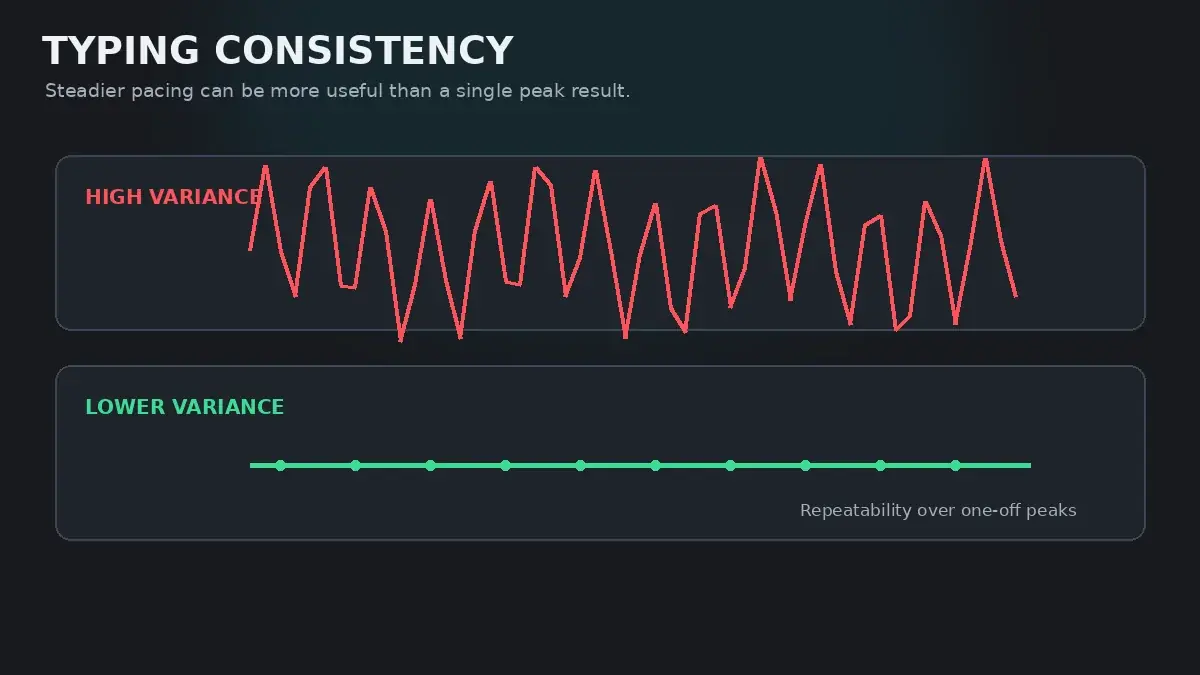
They sprint through common words like the, that, and with at 95 WPM. Then they encounter an unfamiliar word like equilibrium or a semicolon, and their hands freeze for a full second (0 WPM).
This is called burst-and-stall typing. It feels exhilarating because your fingers are sprinting in short bursts, but mathematically, dead stops annihilate your overall score. Consider this simple arithmetic:
- Typist A (Burst & Stall): Types at 90 WPM for 4 seconds, stalls for 2 seconds. Average: 60 WPM.
- Typist B (Metronomic Consistency): Types steadily at 68 WPM without a single pause. Average: 68 WPM.
Typist B feels like they are moving in slow motion, yet finishes substantially ahead of Typist A—with 99% accuracy and zero finger fatigue.
How Consistency Is Measured on HeroTyping
Unlike platforms that only track your total words divided by total minutes, HeroTyping tracks your velocity dynamically from second to second:
- Every 1,000 milliseconds, the engine records your instantaneous Net WPM.
- It calculates the mean velocity and standard deviation across the full test duration.
- It calculates your Consistency Percentage using the coefficient of variation formula:
Consistency % = 100 - (Standard Deviation / Mean WPM * 100)
If your consistency score is above 80%, your typing is exceptionally smooth and rhythmic. If it drops below 65%, your rhythm is plagued by frequent stops and starts.
The Consistency Benchmarks
Evaluate where your current typing rhythm falls on the consistency spectrum:
| Consistency Tier | Statistical Variance | Observable Typing Behavior | Typical WPM Range |
|---|---|---|---|
| 90%–100% (Metronomic Master) | < 10% standard deviation across 1-second slices | Keystrokes sound like rain on a tin roof. Steady, unflinching cadence across easy words, complex syllables, and punctuation. | 70–120+ WPM |
| 75%–89% (Fluent Professional) | 10%–25% standard deviation | Smooth overall flow with occasional micro-pauses before long words, numbers, or capitalization. | 50–75 WPM |
| 60%–74% (Developing / Variable) | 25%–40% standard deviation | Clear burst-and-stall behavior: sprints through short words (the, of) and dead-stops on unfamiliar vocabulary. | 35–55 WPM |
| < 60% (Erratic Spikes) | > 40% standard deviation | Extreme velocity swings: alternating between 80 WPM sprints and 0 WPM freezes while visual searching takes place. | 20–40 WPM |
The Visual Look-Ahead Buffer
The primary neurological reason typists stall is that their eyes are locked on the active word being typed. When your fingers finish typing a word, your brain suddenly realizes it does not know what word comes next. Your hands freeze while your eyes move forward to read the next word.
Skilled typists solve this with the Visual Look-Ahead Buffer (also called the eye-hand span):
- While your fingers are physically typing word N, your eyes must be focused on word N+2 or N+3.
- By reading two words ahead, your motor cortex has already planned the finger movements for the upcoming word before your hands even finish the current one.
- The transition from one word to the next—including striking the Spacebar—becomes completely seamless, with zero dead time.
Cadence and Metronome Drills
To eliminate burst-and-stall habits physically, spend three sessions practicing with an auditory metronome:
- Set a free online metronome to 120 beats per minute (BPM).
- Open the HeroTyping Speed Test and strike exactly one key on every click of the metronome. At 120 BPM, you will type at precisely 24 WPM.
- Focus entirely on keeping your keystrokes glued to the beat. Do not rush easy words; do not hesitate on difficult letters or spaces.
- Once 120 BPM feels effortless, increase the tempo to 160 BPM (32 WPM), then 200 BPM (40 WPM), and finally 260 BPM (52 WPM).
This drill strips away the instinct to sprint and locks in a steady, hypnotic cadence that easily breaks speed plateaus.
FAQ
What exactly is 'Typing Consistency' on HeroTyping?
Typing consistency is a mathematical measure of keystroke timing uniformity. HeroTyping slices your typing session into 1-second intervals, records your instantaneous WPM for each second, and calculates the coefficient of variation (standard deviation divided by mean). The lower your variance, the higher your consistency percentage.
Why does burst-and-stall typing produce lower WPM than steady typing?
Because dead stops are mathematically devastating to averages. If you type at 90 WPM for 3 seconds and freeze for 2 seconds (0 WPM), your 5-second average speed drops to 54 WPM. A typist who maintains a steady, unflinching 65 WPM without ever pausing finishes the text significantly faster.
What is the 'Visual Look-Ahead Buffer'?
The look-ahead buffer is the cognitive ability to read 2 to 4 words ahead of the word your fingers are actively typing. While your fingers execute 'the quick brown', your eyes should already be parsing 'fox jumps over'. This eliminates the hesitation pause at the end of every word.
Can listening to music improve my typing consistency?
Yes, provided it has a steady, unchanging tempo without sudden syncopations or lyrics. Lo-fi beats, ambient synth, or classical baroque music between 100 and 130 BPM can serve as a subconscious auditory metronome, smoothing out irregular typing cadences.
Sources & references
- Eye-Hand Span in Skilled Transcription Typing — Rayner, K. (Cognitive Psychology, 1983)
- Rhythmic Structure and Inter-Keystroke Interval Distribution in Touch Typing — Gentner, D. R. (Acta Psychologica, 1982)
- Motor Timing Variability and the Acquisition of Complex Temporal Skills — Ivry, R. B., & Hazeltine, R. E. (Journal of Experimental Psychology: Human Perception and Performance, 1995)