
How Many Minutes a Day Should You Practice Typing?
The cognitive science of distributed practice, sleep consolidation, and optimal session length.
Core rule
The ideal daily typing practice duration is 15 to 20 minutes. Practicing for longer than 25 minutes produces sharp cognitive fatigue, leading to careless mistakes that degrade muscle memory. Consistency across days matters infinitely more than total minutes in a single day.
The 15-Minute Sweet Spot
When people decide to learn touch typing or increase their WPM, their initial enthusiasm often leads to overtraining. They sit down and type for an hour and a half on Monday. By Wednesday, their forearms ache, their fingers feel sluggish, and their motivation collapses.
Decades of motor learning research reveal a clear consensus: the optimal duration for keyboard skill acquisition is between 15 and 20 minutes per day.
In a 15-minute session, your working memory remains sharp, your inhibitory motor control is active, and your forearm tendons experience zero repetitive-strain fatigue. You finish the session while your accuracy is still high, leaving your brain with a clean, error-free neuromuscular memory trace.
Massed vs. Distributed Practice in Motor Learning
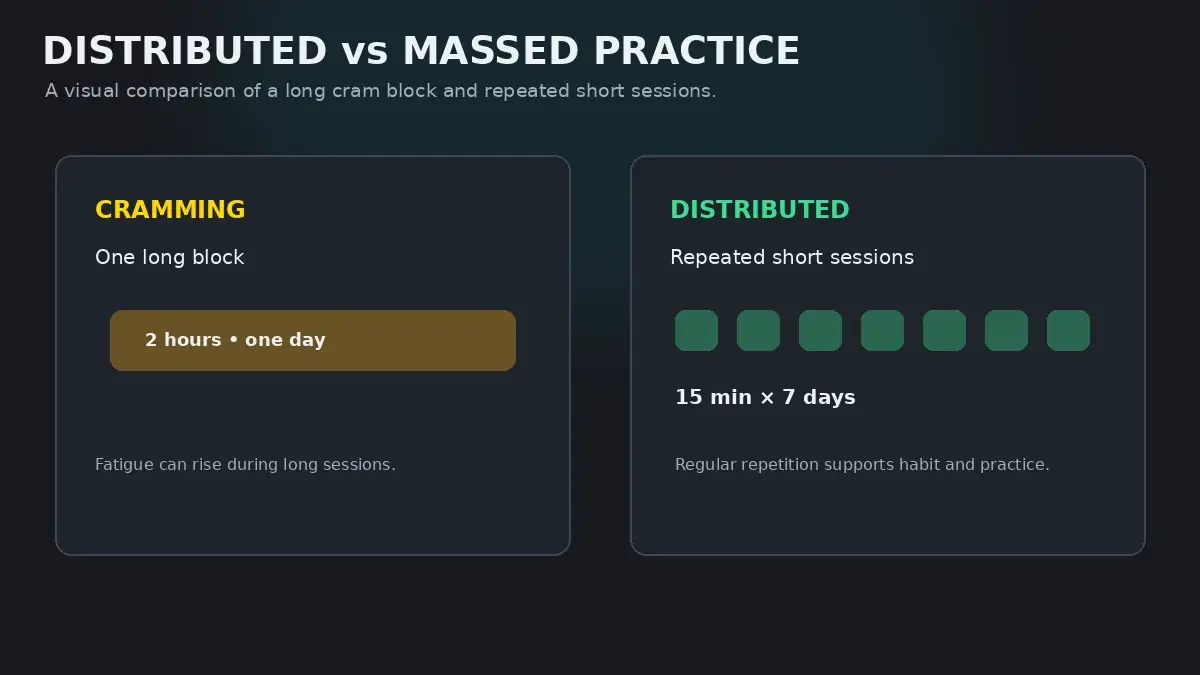
Why does 15 minutes every day outperform a 2-hour weekend marathon by more than 250%?
The answer lies in sleep-dependent synaptic consolidation. When you practice a physical skill like touch typing, your brain does not permanently encode the movements during the practice session itself. Instead, the neural connections in your motor cortex undergo physical structural consolidation (protein synthesis and synaptic strengthening) while you sleep that night.
- Daily 15-Minute Practice: Generates 7 distinct overnight consolidation cycles per week. Every morning, your fingers wake up with previously practiced reaches feeling noticeably more natural.
- Weekend 2-Hour Marathon: Generates only 1 consolidation cycle per week, followed by 6 days of inactivity during which neural pathways experience rapid decay.
Daily Routine Comparison Table
Review how different daily practice schedules translate into real-world motor retention and fatigue:
| Practice Strategy | Weekly Volume | Motor Skill Retention | Neurological Mechanism |
|---|---|---|---|
| 15 Minutes / Day (Recommended) | 1.75 hours across 7 days | Maximum (90%+ retention) | Capitalizes on 7 consecutive sleep-dependent memory consolidation cycles without cognitive fatigue. |
| 30 Minutes / Day (Accelerated) | 3.5 hours across 7 days | Very High (85%+ retention) | Ideal for beginners learning keyboard rows rapidly. Best executed as morning and evening 15-min sessions. |
| 60 Minutes / Day (Heavy) | 7 hours across 7 days | Moderate (Diminishing returns) | Attention drops past 30 minutes; typist begins making sloppy errors that reinforce bad motor habits. |
| 2 Hours on Weekend (Cramming) | 2 hours in 1 day | Extremely Poor (< 30% retention) | Massed practice fails in motor skill acquisition. 6 days of zero practice causes synaptic decay. |
When Practice Becomes Counter-Productive
More is not always better. In psychomotor skills, there is a clear tipping point where further practice becomes actively destructive:
Around the 25-minute mark of continuous typing, your brain's prefrontal cortex experiences glucose depletion. Your reaction time increases, your focus wavers, and your hands begin making careless typos.
When you continue typing in a fatigued state, you are no longer practicing good technique—you are literally practicing and automating mistakes. As soon as you notice your accuracy dropping below 93% on two consecutive drills, stop immediately. Close your browser and let your brain consolidate the session.
Building the Daily Habit in HeroTyping
HeroTyping makes daily consistency effortless through intelligent daily recommendations:
- Visit the HeroTyping Lessons Dashboard every morning or during a work break.
- Inspect the Today's Training recommendation card, which automatically selects the exact lesson module or weak-key drill best suited for your current stage.
- Complete your recommended 15-minute block, log your progress, and get on with your day.
FAQ
Can I practice typing for 2 hours on Sunday instead of 15 minutes every day?
No. In neuroscience, this is the classic 'Massed vs. Distributed Practice' error. Motor memory is not consolidated during the typing session itself; it is physically consolidated in the brain's motor cortex during deep sleep following the session. Practicing 15 minutes a day gives you 7 consolidation cycles per week. Practicing 2 hours on Sunday gives you only 1 consolidation cycle, with 85% of that effort lost to cognitive fatigue.
At what point in a practice session do diminishing returns kick in?
For most learners, cognitive and muscular diminishing returns begin at approximately 20 to 25 minutes of continuous typing. Beyond 25 minutes, error rates spike by 40% and finger response latency slows down. Once you notice yourself making careless errors, continuing to practice actually trains mistakes into your muscle memory.
Is it better to practice once a day for 30 minutes or twice a day for 15 minutes?
Twice a day for 15 minutes is significantly superior. Splitting practice into morning and evening sessions creates two distinct sensorimotor learning bouts, doubles your recovery periods, and prevents forearm flexor fatigue.
How many total practice hours does it take to reach 60 WPM from scratch?
With disciplined daily 15-minute practice, an average adult reaches 55 to 65 WPM touch typing within 15 to 25 total practice hours—which equates to roughly 8 to 12 weeks on the calendar.
Sources & references
- Spacing Effects in Learning: A Temporal Distribution Analysis of Motor Skills — Cepeda, N. J., et al. (Psychological Bulletin, 2006)
- Sleep-Dependent Consolidation of a Motor Skill in the Human Brain — Walker, M. P., et al. (Neuron, 2002)
- Distributed Practice and the Optimisation of Cognitive and Motor Learning — Baddeley, A. D., & Longman, D. J. (Ergonomics, 1978)