
Bottom Row Typing Practice: ZXCVBNM
Downward curling mechanics, wrist clearance, and finger assignments for the most challenging row on the keyboard.
Biomechanical rule
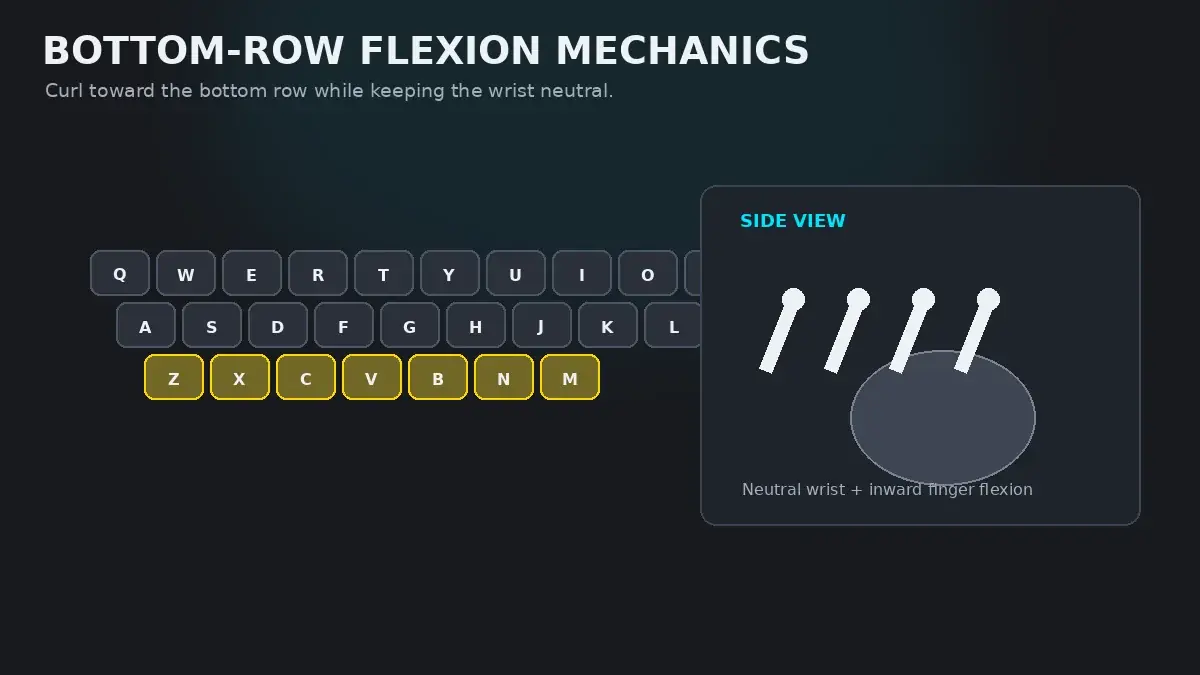
Never collapse or plant your wrists when typing the bottom row. Curling your fingers downward into the palm requires vertical clearance. Keep your wrists floating 1 to 2 centimeters above the desk surface so your fingertips can curl cleanly under your knuckles.
The Biomechanical Challenge of the Bottom Row
Ask any group of typing students which row gave them the most trouble, and the unanimous answer is the bottom row: Z, X, C, V, B, N, M.
There is a clear anatomical reason for this difficulty. Extending your fingers upward to the top row uses your forearm's extensor muscles, which open the hand into a broad, relaxed posture. Curling your fingers downward to the bottom row uses the deep flexor tendons, folding the fingertips backward toward your palm.
If your wrists are resting flat on your desk or laptop chassis, your fingers literally run out of physical space to curl. Typists who plant their wrists end up bending their fingers at awkward sideways angles, causing frequent adjacent slips (like typing C instead of V) and rapid forearm fatigue.
Complete Finger Assignments (ZXCVBNM)
Review each finger's downward trajectory from its resting home position:
| Finger | Home → Bottom | Trajectory Angle | Biomechanical Mechanics |
|---|---|---|---|
| Left Pinky | A → Z | Down and slightly right | Curl the pinky joint tightly inward toward the palm. Avoid rotating the wrist outward. |
| Left Ring | S → X | Down and slightly right | Curl the ring finger directly down. Maintain the middle finger close to D for stability. |
| Left Middle | D → C | Down and slightly right | A strong, natural downward curl. One of the most frequently used bottom-row consonants. |
| Left Index | F (Anchor) → V and B | V: Down-right curl; B: Extended down-right diagonal stretch | Left index owns both V and B. The reach to B is the widest diagonal reach on the bottom row. |
| Right Index | J (Anchor) → N and M | N: Down-left diagonal stretch; M: Down-left direct curl | Right index owns N and M. Never allow the left hand to cross over and strike N. |
| Right Middle | K → , (Comma) | Down-left direct curl | Extremely common in sentence flow. Needs sharp, rhythmic tap and instant return to K. |
| Right Ring | L → . (Period) | Down-left direct curl | Direct downward curl past L. Used to terminate sentences and domain names. |
| Right Pinky | ; → / (Slash / Question Mark) | Down-left curl | Controls forward slash and (with Shift) question mark. Keep right elbow stable. |
The Crucial B and N Divide
The center of the bottom row contains one of the most persistent bad habits in typing: the crossover reach between B and N.
On standard QWERTY keyboards, the B key sits almost equidistant between the hands. Many self-taught typists strike B with their right hand, or alternate hands haphazardly depending on which word they are typing.
This inconsistency destroys typing rhythm. Lock in this fundamental rule:
- The Left Index Finger ALWAYS owns B: It reaches down and diagonally right from the
Fanchor key. - The Right Index Finger ALWAYS owns N: It reaches down and diagonally left from the
Janchor key.
Assigning strict hand ownership ensures that when typing common letter combinations like nb, bn, or words like banana and combine, both hands can execute fluid alternating strokes without crashing into each other.
The Wrist Clearance Secret
To make bottom-row typing feel effortless rather than cramped, adopt the Arch Posture:
- Curve your fingers as if you are gently holding a tennis ball or ripe peach in each palm.
- Lift your wrists so that they float straight with your forearms—no downward sag, no backward bend.
- When striking
Z,X,C, orV, let the finger curl down like a small hammer tapping the keycap squarely in the center. - Immediately spring back to the home row. Never leave your fingers resting on the bottom row.
Progressive Practice Drills
Work through these four drills in sequence to build unconscious bottom-row reflex:
Drill 1: Left-Hand Bottom Row Curls (Z, X, C, V, B)
aza sxs dcd fvf fbf fbf fvf dcd sxs aza cab vat box zoo verb
Drill 2: Right-Hand Bottom Row Curls (N, M, Comma, Period)
jnj jmj k,k l.l ;/; jnj jmj man men moon name nine fine line
Drill 3: The B and N Alternating Index Drill
bfb jnj bnb nbn ban nab bean bone barn bond bend blend cabin
Drill 4: Full Three-Row English Vocabulary
brave zinc exact voice never climb brown blank examine volume carbon
Ready to put these mechanics into practice with real-time accuracy scoring? Jump into the structured bottom-row modules in HeroTyping Lessons:
- Lesson 9: Bottom Row Left (Z, X, C, V, B)
- Lesson 10: Bottom Row Right (N, M, Punctuation)
- Lesson 11: Bottom Row Combined Practice
- Lesson 12: Bottom Row Integrated Real Words
FAQ
Why does the bottom row feel so much harder to type than the top row?
Human hand biomechanics naturally favor extension (opening fingers upward) over tight flexion (curling fingers backward under the palm). Reaching downward compresses your finger tendons toward your palm. If your wrists are planted flat against your desk, this curl is physically obstructed, creating friction and strain.
Which hand should type the letter B?
In standard touch typing, the letter 'B' belongs exclusively to the left index finger reaching down and right from 'F'. Because 'B' sits centrally between the hands, many self-taught typists develop the bad habit of striking it with their right index finger. Break this habit early: left hand types 'B', right hand types 'N'.
How do I avoid hitting C when aiming for X?
Because the keyboard rows are staggered, beginners often reach straight down from 'S' and hit 'C' instead of 'X'. Remember that the bottom row staggers to the right relative to the home row: 'X' is reached by curling down and slightly right, while 'C' is reached from 'D'. Keep your middle finger anchored on 'D' as a reference guide.
Should my palms rest on a wrist rest while typing bottom-row keys?
No. Wrist rests are designed for resting during pauses between typing bouts, not for anchoring your hands while active keystrokes occur. Resting your palms while typing down-row keys forces severe wrist dorsiflexion, pinching the median nerve in the carpal tunnel.
Sources & references
- Carpal Tunnel Pressure and Tendon Travel During Keyboard Operations — Rempel, D., et al. (Journal of Bone and Joint Surgery, 1999)
- Biomechanical Evaluation of Flexor Tendon Loading in Rapid Finger Tapping — Dennerlein, J. T., & Johnson, P. W. (Ergonomics, 2006)
- Kinematic and Electromyographic Comparison of Touch-Typing Techniques — Baker, N. A., & Cidboy, C. (Work: A Journal of Prevention, Assessment and Rehabilitation, 2006)